The Shooting in Dealey Plaza
Three Shots, Three Victims, Three Shells
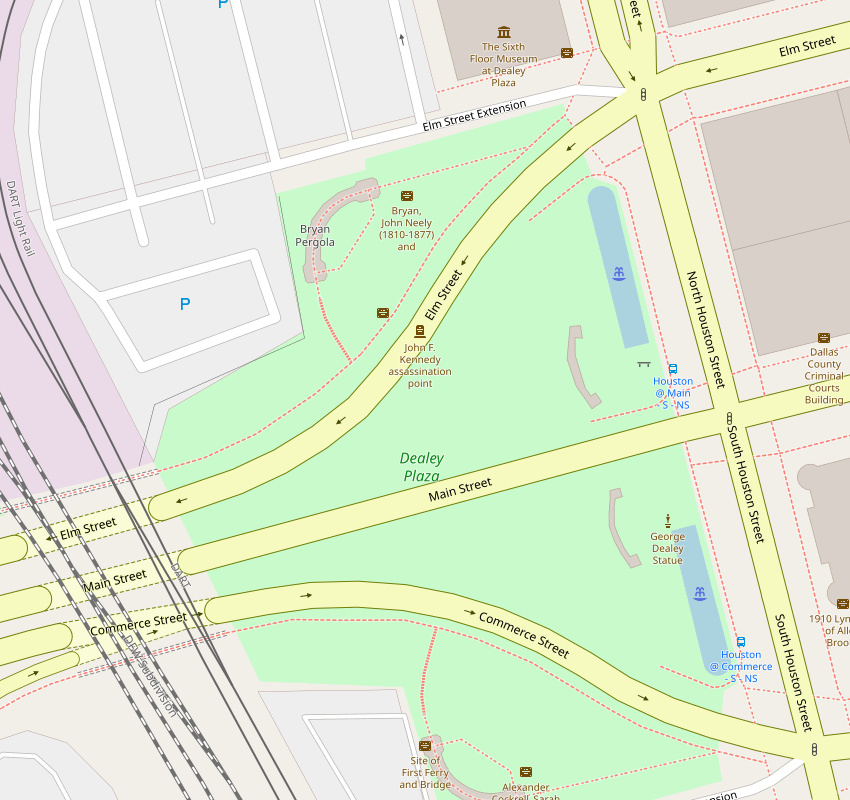
On 22 November 1963, President John F. Kennedy was a passenger in a motorcade through the centre of Dallas, Texas. At about 12:30pm, the motorcade was in Dealey Plaza, just outside the downtown area, when several gunshots were fired.1 Altogether, three people were injured:
- President Kennedy was wounded in the back and the throat, and, fatally, in the head.2
- The governor of Texas, John Connally, who was sitting directly in front of Kennedy, sustained three wounds:
- one bullet hit him in the back near his right armpit, damaged four inches of one rib, punctured his right lung, and came out of the right side of his chest;
- his right wrist was shattered;
- and a fragment of a bullet was embedded in his left thigh.3
- A bystander, James Tague, received a slight cut on the cheek from the impact of a bullet to the concrete curb near his feet.4
The Bullet Shells and the Rifle
At the time of the shooting, the presidential limousine was heading west on Elm Street, and had just passed the Texas School Book Depository, which contained publishers’ offices and a book warehouse. A window was half open at the eastern end of the sixth floor of the building.5 Three empty bullet shells were discovered just inside this window. Elsewhere on the sixth floor, a rifle was discovered. Tests showed that those bullet shells had been fired from that rifle.6
Lee Harvey Oswald and the Sixth-Floor Rifle
The rifle had been purchased several months earlier by mail order. The name on the mail order coupon was a pseudonym known to have been used elsewhere by Lee Harvey Oswald. The handwriting on the coupon matched Oswald’s. The supplier had sent the rifle to a post office box rented by Oswald.7
Oswald at the Scene of the Crime
Oswald worked in the Texas School Book Depository, and had legitimate access to the sixth floor. He claimed to have been elsewhere at the time of the shooting, but there were no eye-witnesses to support his alibi.
Two Solutions to the JFK Assassination
On the face of it, this is an open-and-shut case: Oswald did it. The only realistic alternative is that Oswald had been carefully framed in advance.
The other, purely theoretical, solution, that some other lone nut happened to stumble across Oswald’s rifle and decided to take a few pot shots at the president, is too unlikely to be worth considering.
Either Oswald did it, or he was set up. Let’s examine each of these options in turn.
Footnotes
Abbreviations
The sources cited in this website use the following abbreviations:
- ARRB
- Assassination Records Review Board
- CD
- Warren Commission Document (not officially published, but placed in the National Archives)
- CE
- Warren Commission Exhibit (published in the 26 volumes of Hearings and Exhibits)
- HSCA
- House Select Committee on Assassinations
- NARA
- National Archives and Records Administration
- RIF
- Record Identification Form (for documents stored at NARA)
- WCHE
- Warren Commission Hearings and Exhibits
- WR
- Warren Report
- The basic, uncontested facts of the JFK assassination can be found in the Warren Report. ↵
- Lack of agreement about the exact location and nature of the president’s wounds is the main reason why the JFK assassination remains controversial. President Kennedy’s autopsy was carried out poorly: his back and throat wounds were not dissected, and none of his wounds were measured or photographed with adequate precision. The two official interpretations of the medical evidence differ in crucial ways; see WR, pp.86-91 and the House Select Committee on Assassinations Report, Appendix vol.7, pp.80-137. ↵
- For Governor Connally’s chest wound, see Warren Commission Hearings and Exhibits, vol.4, p.104. For his wrist wound, see ibid., pp.118-124. ↵
- James Tague’s wound: WR, p.116. ↵
- This is the American definition of ‘sixth floor’; in the UK and many other places it would be the fifth floor. All such references will use the American definition. ↵
- For the discovery of the bullet shells and the rifle, see e.g. WCHE, vol.6, pp.300-1. The bullet shells were matched to the rifle by Robert Frazier of the FBI: WCHE, vol.3, pp.421-37. ↵
- A photograph of the envelope and mail order coupon for the rifle: WCHE, vol.19, p.275. Identification of the handwriting as Oswald’s: WCHE, vol.24, p.759 (Commission Exhibit 2145). For Oswald’s use of post office boxes, see WCHE, vol.20, p.177. Oswald’s use of ‘A. Hidell’ as an alias will be discussed in The Career of Lee Harvey Oswald. The man now universally known as Lee Harvey Oswald rarely used his middle name except in official documents; he usually called himself either Lee Oswald or, in the American fashion, Lee H. Oswald. ↵